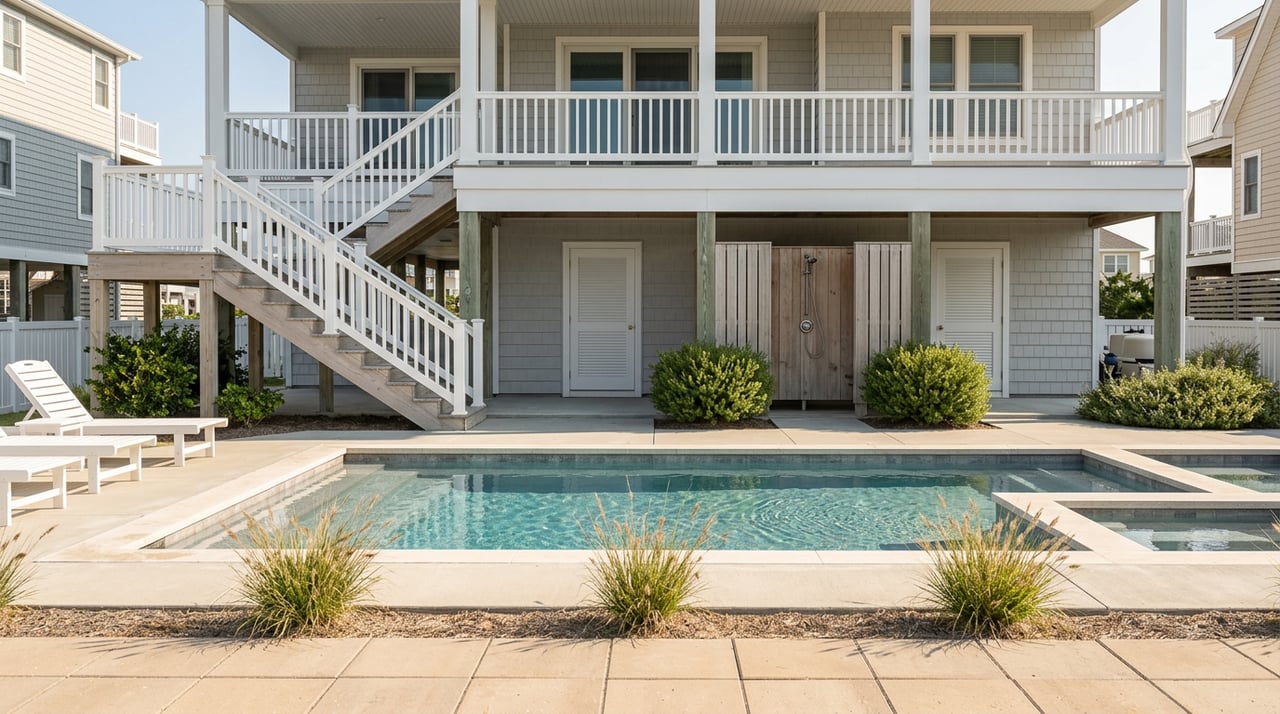
Thinking about a Corolla beach home that helps pay for itself? You’re smart to ask how it might perform as a vacation rental before you buy. With strong summer demand and beach logistics to consider, a clear process will save you time and money. Most rental homes on the OBX for sale provide the property's rental history, which you can ask your agent to share with you. If there is no rental history, the following will help guide you through a step-by-step framework, the key data sources, and a simple way to build a first-pass projection. Let’s dive in.
Quick 15-minute screen
Use this fast checklist to decide if a property deserves deeper analysis:
- Verify beach position. Is it true oceanfront or oceanside, and how is beach access handled? Start by reviewing the differences in our overview of oceanfront vs. oceanside in Corolla.
- Check 4x4 logistics. If it is in the Carova/4x4 area, confirm how guest beach parking permits are provided each week. Review county guidance on beach parking rules and permits.
- Scan summer pricing. Pull 3 to 6 similar homes on your preferred platform and note weekly July rates, cleaning fees, and amenities.
- Note tax obligations. Currituck (and Dare) requires a 6% local occupancy tax on short-term rentals, in addition to state sales tax. See the county’s occupancy tax rules.
Seasonality in Corolla
Corolla’s rental market is seasonal. County lodging-tax collections show clear summer peaks with lighter winter activity. Use the monthly series to shape your model rather than assuming uniform demand. Review the county’s monthly occupancy tax collections to build a realistic month-by-month curve.
A practical takeaway: many homes earn most of their revenue in roughly 12 to 14 peak weeks. Small shifts in peak-week pricing, cancellations, or weather can move annual results. Model peak, shoulder, and off-season separately so you see where risk and opportunity sit.
What guests pay for
Target the amenities that move the needle in Corolla:
- Oceanfront or direct, simple beach access. Verify access rights and the exact walk beach.
- Pool and hot tub. These boost rates and can extend shoulder-season demand.
- High-speed Wi-Fi and a simple workspace. Useful for remote workers and longer shoulder stays.
- Pet-friendly policies. Popular with family groups but plan for extra cleaning and clear house rules.
- Elevator and parking capacity. Important for multi-level homes and multi-generational groups.
When comparing comps, cluster by bedroom count, oceanfront vs. non-oceanfront, pool/hot tub, and whether the property is in the 4x4 area. Always compare the same weeks.
Step-by-step evaluation framework
Step A: Clarify goals
- Decide your use pattern: full-time rental, hybrid use, or light rental around personal stays.
- Define your target guest (families, multi-generational groups, pet owners, remote workers). This drives your amenity plan and marketing.
- Set your minimum stay, turnover frequency, and housekeeping standards to match your plan.
Step B: Collect comps and price points
- Start with a market snapshot. Pull Corolla metrics by bedroom count from AirDNA’s market overview. Note ADR, occupancy, and RevPAR.
- Manually check platforms. For 6 to 12 close comps, record weekly rates for two July weeks, one spring or fall week, and one winter week. Capture cleaning fees and key amenities.
- Document differences. If a comp has a pool, elevator, or is oceanfront, note it so you can adjust your target up or down.
Step C: Convert comps to revenue
Use one of two methods:
- Simple market formula for a quick screen: Annual revenue ≈ ADR × Occupancy × 365. This gives a ballpark using market averages.
- Seasonal method for Corolla: Segment the calendar into Peak, Shoulder, and Off-season. For each segment, multiply your typical weekly price by the share of weeks you expect to book. Sum the segments. Calibrate the monthly share using the county’s monthly collections.
Tip: If you have month-level ADR and occupancy from AirDNA or observed calendars, build a month-by-month table for better accuracy.
Step D: Build the expense budget
Create a complete annual operating list so your projection reflects reality:
- Management fee. Full-service programs often range from 15% to 30%. See benchmarks in this management fee guide.
- Cleaning and laundry. Costs scale with size and pools/hot tubs. For context on ranges and scope, review these cleaning fee benchmarks.
- Utilities and internet. Budget for peak-season usage and high-speed service.
- Linens, supplies, routine maintenance, and a capital reserve. Coastal homes need steady upkeep.
- Insurance and property taxes. If in a flood zone, plan for flood coverage.
- HOA dues and permit-related costs if applicable.
- Taxes. Owners must collect and remit Currituck’s 6% occupancy tax and applicable state sales tax. See county tax rules.
A simple starting reserve is 5% to 10% of gross revenue for repairs and replacements.
Step E: Model cash flow and sensitivities
Build a simple worksheet with these inputs: purchase price, loan terms, property tax, insurance, HOA, utilities, management percentage, cleaning, platform fees, and your ADR/occupancy by month or segment.
Calculate: Gross rental revenue, total operating expenses, net operating income (NOI), cash flow after financing, cap rate, and cash-on-cash return. Then stress test:
- ADR up or down 10% to 15%.
- Occupancy up or down 10% to 20%.
- Peak-week shock. If your top 4 summer weeks do not book, how does that affect the year?
Step F: Operational due diligence and red flags
Before you write an offer, confirm the items that can make or break performance:
- HOA rules. Request recorded covenants and confirm short-term rental allowances and parking limits.
- County registration and taxes. Verify current collection and filing requirements on the county’s occupancy tax page.
- Septic capacity. Make sure permitted bedrooms and occupancy match your marketing plan.
- Flood zone and insurance. Check FEMA maps and request quotes. See local planning context in this Currituck flood reference.
- Beach parking logistics. If in the 4x4 area, confirm how guest permits are issued and returned. Review county beach parking rules.
- Contracts and deposits. North Carolina’s Vacation Rental Act outlines written-agreement basics and consumer protections. Review the statute at Chapter 42A.
A simple example, step by step
Here is how to structure a first-pass projection without committing to exact numbers:
-
Pick your segment. Example: 5-bedroom oceanside with pool.
-
Set pricing anchors. Use your July weekly average from comps as Peak rate. Use May and September for Shoulder, and a winter week for Off-season.
-
Assign booking assumptions. For example, assume near-full booking in Peak, partial in Shoulder, and light in Off-season. Calibrate monthly distribution using the county’s collections curve.
-
Sum gross revenue. Add Peak, Shoulder, and Off-season revenue.
-
Subtract expenses. Apply your management percentage, add cleaning per turnover, taxes, utilities, insurance, HOA, and reserves.
-
Review cash flow. Layer in financing if applicable and test your sensitivities. You now have a realistic range instead of a single number.
When to bring in local pros
Call in deeper help if any of the following apply: unclear HOA rules, flood-zone complexity, septic capacity questions, or a property in the 4x4 area with permit logistics. If you need a lender-ready pro forma, consider purchasing a targeted market report and ask a reputable local manager for anonymized owner statements to compare against your model.
Ready to evaluate a specific property or build a tailored pro forma? Reach out to our boutique team at Corolla Real Estate. We combine decades of local rental know-how with white-glove guidance to help you buy with confidence.
FAQs
What taxes apply to Corolla vacation rentals?
- Currituck requires a 6% local occupancy tax, collected in addition to state sales tax. Owners are responsible for proper registration and remittance per county guidance.
How seasonal is Corolla’s rental demand?
- Very seasonal. County lodging-tax collections peak in summer and drop in winter. Use the monthly collections to shape your monthly revenue model.
How do 4x4 beach permits affect guests and operations?
- If the home is in the Carova/4x4 area, guests need county-issued beach parking permits during the season. Confirm how permits are supplied and reviewed via county beach parking rules.
Which amenities increase rates most in Corolla?
- True oceanfront or simple beach access, private pool and hot tub, fast Wi-Fi, pet-friendly policies, and features like an elevator and ample parking typically support higher ADRs and stronger shoulder demand.
What should I check before making an offer on a rental property?
- Verify HOA rules, septic capacity, flood zone and insurance, beach access and 4x4 permits if applicable, and your tax and contract requirements under North Carolina’s Vacation Rental Act.