If you've been comparison-shopping Kitty Hawk against its neighbors on a portal, you've probably run into a number that seems too good, or too alarming, to be true. Over the three months ending in May 2026, the median sale price in the Kitty Hawk Beach neighborhood jumped 58.8 percent year over year to $1.1 million. That sounds like a market on fire. But look one line down on the same data and the price per square foot in that same neighborhood, over that same stretch, fell 38.9 percent to $511.
Those two numbers cannot both describe the same houses getting more valuable. They describe something else: a shift in which houses happened to sell. And that shift is the real story for anyone trying to figure out what Kitty Hawk actually costs right now.
Why the Median Went Up While the Price Per Square Foot Went Down
A rising median with a falling price per square foot is a classic sign that bigger, less expensive-per-foot homes made up more of the sales mix than usual. It doesn't mean the market got cheaper on a foot-for-foot basis and it doesn't mean it got 58 percent more expensive either. It means the typical buyer who closed in that window walked away with a larger house, and larger houses tend to cost less per square foot than small, tightly built oceanfront cottages, simply because square footage gets cheaper to add once you're past the first bedroom and bathroom.
Kitty Hawk is an unusually good place to watch this happen, because the town is genuinely split into two housing stocks that rarely compete for the same buyer.
The Bypass Is the Real Dividing Line
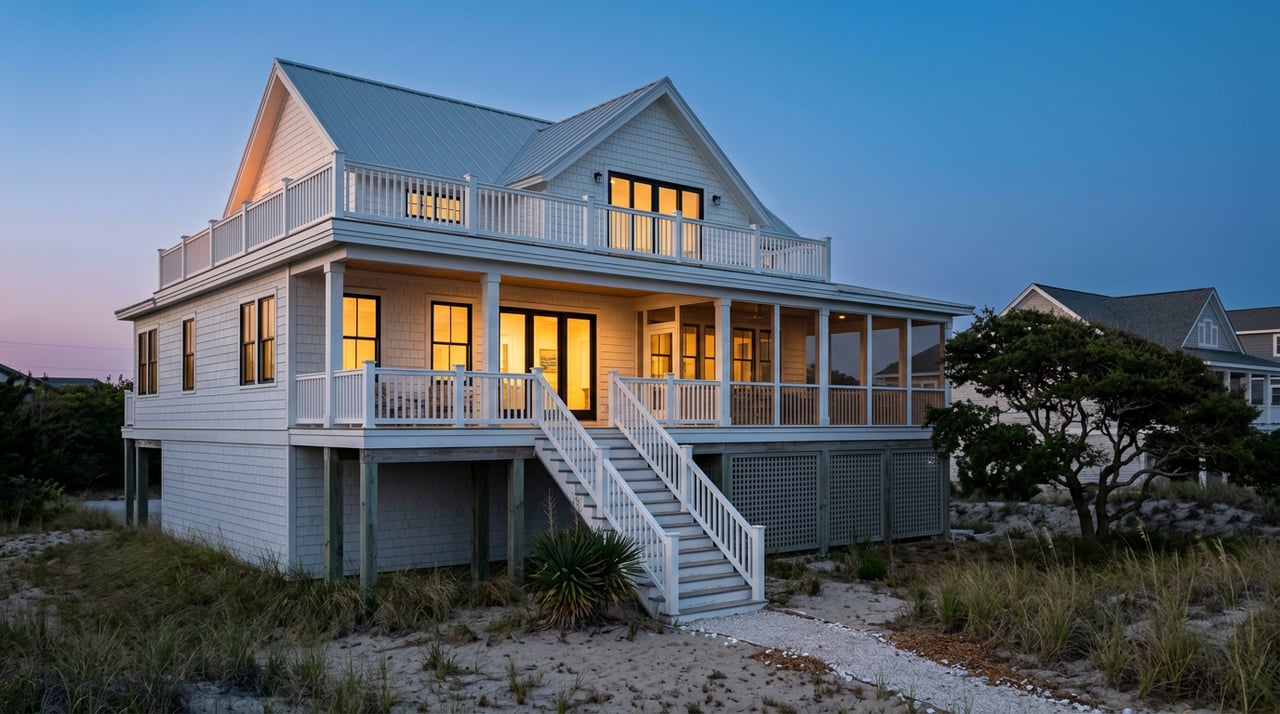
Kitty Hawk's oceanfront, the strip east of the Bypass, is still largely built out with the older, smaller cottages that gave the whole northern Outer Banks its beach-town character: fifty-foot lots, modest footprints, a handful of amenitized communities like Sea Dunes with a pool and tennis courts a short walk from the sand. These homes carry a scarcity premium. There's no more oceanfront to build, so every square foot of it costs more, which is exactly why the Kitty Hawk Beach price-per-foot number has historically run high.
West of the Bypass is a different town entirely. The original Kitty Hawk village sat on the sound side for generations before the Wright brothers ever arrived, and much of that land is now the town's maritime forest, canal, and sound-access communities. Kitty Hawk Landing offers canal and sound frontage with room to build wider, deeper homes. Martin's Point is a gated soundfront community where lot sizes support genuinely large houses. Sea Scape wraps around its own golf course. Sandpiper Cay adds condos on the soundside for buyers who want a lower entry point. None of this land is scarce in the way oceanfront is, so builders can add square footage more cheaply, and buyers get more house for the dollar even when the total price tag is bigger.
The oldest building tied to Kitty Hawk's identity isn't a house at all. The Black Pelican restaurant occupies the site of the former Kitty Hawk Lifesaving Station, the building that held the nearest telegraph when the Wright brothers needed to send word of their first flight back to the mainland. It's a small detail, but it's a useful reminder that "oceanfront Kitty Hawk" and "soundside Kitty Hawk" have been two distinct settlements for well over a century, long before either one had a modern price tag.
Here's the practical comparison, based on what's currently selling and where:
| East of the Bypass (Oceanfront) | West of the Bypass (Soundside / Maritime Forest) | |
|---|---|---|
| Typical stock | Older, smaller cottages on narrow lots; some newer rebuilds | Larger homes, canal and soundfront lots, golf course frontage |
| Named communities | Kitty Hawk Beach, Sea Dunes | Kitty Hawk Landing, Martin's Point, Sea Scape, Sandpiper Cay |
| What drives price per square foot | Scarcity of oceanfront land | Room to build larger footprints |
| Typical buyer motivation | Rental income, walk-to-beach lifestyle | Primary or long-term residence, boating and sound access |
When a batch of larger soundside homes closes in the same window as a handful of small oceanfront cottages, the blended town-level median moves in a direction that doesn't describe either market accurately on its own. That's what happened this spring.
What the Town-Wide Number Was Doing at the Same Time
Zoom out from the Kitty Hawk Beach neighborhood to the town as a whole and the picture calms down considerably. As of May 2026, the median sale price for all of Kitty Hawk stood at $625,626, up a much more modest 10.2 percent year over year. That's a real but unremarkable increase, nowhere near the neighborhood-level swing.
By mid-August 2026, the most recent read available put the townwide median even closer to flat, around $720,000 with essentially no year-over-year change. Homes were sitting on the market for a median of 114 days, up sharply from the 64-day average recorded the previous December. Active inventory sat at 42 homes, representing roughly 3.2 months of supply, and sellers were closing at about 97 percent of asking price with no homes selling above list. That's a market that's cooled and shifted some leverage back toward buyers, which is a very different story than "prices are up nearly 60 percent."
Both readings are accurate. They're just describing different slices of the same town in different windows, and the gap between them is the point. A single median price, pulled from a portal without knowing which neighborhood or which months fed into it, tells you almost nothing about what a specific house on a specific street is actually worth.
What This Means If You're Comparing Kitty Hawk to Its Neighbors
If you're cross-shopping Kitty Hawk against Southern Shores, Kill Devil Hills, or Duck using a single headline price, you're comparing numbers that were built from very different housing mixes without knowing it. The fix isn't complicated, but it does take a step most online searches skip: ask which side of the Bypass a comparable sale actually sits on before you use it to judge value.
A buyer chasing rental income and walkability wants to know what's moving on the oceanfront strip, where the inventory is older, smaller, and priced by the square foot at a premium. A buyer looking for a primary residence or a boat slip in the backyard wants to know what's moving on the sound side, where more square footage is available for less per foot but the lifestyle trades ocean proximity for water access of a different kind. Blending those two markets into one number flatters neither buyer.
This is exactly the kind of local read that a portal's citywide chart can't give you, and it's the reason a market snapshot is only useful when someone can walk you through which neighborhood, which comparable sales, and which months are actually driving the number you're looking at.
A Few Questions Worth Asking Before You Trust a Kitty Hawk Price Number
Is Kitty Hawk's market heating up or cooling down right now? Both, depending on where you look. The overall town has cooled through 2026, with days on market roughly doubling by August compared to the previous December and inventory sitting closer to buyer's-market territory. Specific pockets, particularly where a few larger homes have closed recently, can still show sharp short-term price swings that don't reflect the broader trend.
Should I care more about median price or price per square foot? Neither number alone tells the full story. Median price reflects what's actually closing, which can be skewed by a handful of unusually large or small sales in a short window. Price per square foot normalizes for size but can still be distorted by a run of oceanfront versus soundside closings. The two together, read side by side, are what actually reveal whether a market moved or just changed shape.
Does the east side or west side of Kitty Hawk appreciate faster? The research doesn't support a clean answer to that question, because the two sides serve different buyers with different priorities, oceanfront scarcity versus soundside space, and their price signals move for different reasons in different years. Anyone who tells you one side categorically outperforms the other is oversimplifying a town that has run as two markets for longer than it's been one.
Numbers pulled from a portal can only tell you what happened to the average house that happened to sell. If you want to know what a specific property in Kitty Hawk, or anywhere else on the northern Outer Banks, is actually worth in today's market, Corolla Real Estate can walk you through the comparables that actually apply to your side of the Bypass. Get your instant home valuation or schedule a private consultation to talk through what the current data means for your specific goals.